
The Genoese Affair
- Jun 5
- 7 min read
As I write this, Missy Bear is still tied up in Marmaro, on Chios. Our Windy app predicted a thunderstorm and heavy rain. And on cue, it happened. One crack of thunder accompanying a flash was directly overhead, and so loud I thought I had been shot. Not a day to leave port and go sailing. The rain has brought down an overpoweringly, wonderful aroma of aromatic herbs from the surrounding hills. On a more negative note, the clear harbour water is now a turbid brown filled with the out-washings of the local stream.

The persistent, strong, southerly winds have blocked Missy Bear’s comfortable passage southward. So, the crew hired a car, and spent a couple of days exploring this beautiful island: we drove past limestone mountains; through olive and mastic groves, and pine forests; enjoyed the colours of pink oleander bushes, and swathes of yellow-flowering broom: visited open beaches and tiny rocky coves; gaped at Byzantine churches and monasteries; wandered around medieval villages, and the villas and estates of old, wealthy, merchant families.

Marmoro is an old and charming port and village, and a lot of the buildings need some TLC. But other do not: the families of the Greek shipping diaspora – now residing in Piraeus, London, Monaco etc - still keep second homes on Chios, and the nearby naval college island of Oinousses. This keeps them rooted to their boating origins: even Christopher Colombus visited Chios to pick up some nautical tips.
And - bear with me on this - those maritime origins can be traced back to Mohammed, and the early Islamic Arab conquests of the late first Millennium [Ships from the Desert]. The Muslims had conquered Syria, Iraq, Persia, North Africa and the Iberian Peninsula, and would later head north from Syria into Anatolia, and to the Balkans via the Black Sea. I argued in that blog, that the Mediterranean Sea had proved to be a formidable barrier against the attempted Islamic conquest of western Europe.
That’s not to say that their ships did not try. For example, I hadn’t realised until recently that, in 934–35, Genoa was thoroughly sacked and burned by a Shia Muslim fleet (a Fatimid fleet from Egypt). It is argued that, as a result, the Genoese decided to build their own fleet as protection against further attacks. This fact is crucial to the thesis.
I have talked at length about Venice’s maritime empire in other blogs, but only mentioned the Genoese in passing. Genoa also became a strong maritime republic as a result, with Venice being its strongest, perennial competitor. Only when the Pope ordered these two forces to co-operate, e.g. against ongoing Islamic threats, did this commercial rivalry temporarily abate. For example, the Genoese provided many ships to transport ‘Franks’ on the First Crusade. Like Venice, the Genoese were primarily merchants seeking a profit from risk-taking trade. They started trading around the Mediterranean, establishing outposts in the eastern Mediterranean and Black Sea.
After the Fourth Crusade, and the sack of Constantinople, the hated Venetians had claimed most of the spoils of the Greek-speaking, eastern Roman Empire. But in 1261, the Genoese formed an alliance with the displaced Greeks, and re-took Constantinople. Genoa also took control of islands, including Lesbos and Chios. And the Genoese influence on both islands has been dramatic and long-lasting. It could be plainly seen everywhere in the landscape. On Lesbos, the Genoese had industrialised olive oil production, which involved felling large areas of native pine forest and planting olive groves in their place.
On Chios, the island was already famed for its mastic before the Genoese arrived. But they secured and industrialised its production. Again, much of the native pine forest would have made way to groves of olive trees and mastic trees.

Mastic is the sap that oozes from wounds on the small native tree, Pistacia lentiscus (a relative of the Pistacia tree). According to Greek Orthodox tradition and Chian folklore, Saint Isidore was martyred in the third century during the reign of Roman Emperor Decius, because he refused to renounce his Christian faith.
Some sources claim he was tied to a wild horse and dragged through the villages of southern Chios until he died. As he shed his blood, the mastic trees along the route began to "weep". The resin droplets represent the martyr's tears.
The trees have been bred and improved for centuries, and the Chian varieties are unique. Trees start weeping when incised at about 7 years old, and continue to do so until they reach 50 years old, although production tails off dramatically with age, and the older trees are only bled every other year. A good tree in its prime can produce 150 grams per day, a poor one only 10g.

Mastic was, and still is, used for various medical and flavouring purposes, and it was literally worth its weight in gold. Which was good news for the locals, as the horticulture, scarring, collecting, storing/drying, washing and hand cleaning tasks, is the most labour-intensive process I can imagine. It involved everyone in the medieval villages, mostly processing the pearls in their own homes: a cottage industry, but on an industrial scale.
As the islands were still under constant threat from Arab Muslim pirates, latterly the Ottoman Turks, the Genoese secured the production by fortifying the mastic-producing villages, and bringing the population in from the countryside. The villages were already a confusing warren of single-story houses, with few windows, but the Genoese created an outer wall comprising two-story, terraced, houses with no openings on the outer wall. They constructed a large central tower, as a place of final refuge, and corner towers for surveillance and communication.

There are a dozen or so of these mastic villages – or Masrichachoria – on the south of Chios. Missy Bear visited Pyrgi, Olympoi and Mesta, staying overnight in the latter, in a small, one-room space with one small window, in one of the corner towers. Charming, if you like 14th century comfort.
I have a pretty good sense of direction, but I have been thoroughly confused twice: once in the souk of Marrakesh; and the second, yesterday, in the narrow, often dead-end streets of Olympoi.
The buildings are constructed from rough, local, limestone rubble, with worked stone for door and window surrounds. Some of the limestone has an orangey-red hue, due to its high iron content, and reminds me of the ironstone in the north Cotswolds.

Some walls (on higher-status buildings, I assume) are rendered with layers of different-coloured render – normally a white layer over a darker layer. Whilst the latest coat is still not set, it is scraped off in geometric patterns to reveal the darker layer below. Locally this style is called ‘xysta’, but it is believed that this process was imported by the Genoese, who knew it as ‘Sgraffito’ in Renaissance Italy.
The Genoese influence came finally under the control of a private stock company called Maona, which controlled all trade in all the islands products in exchange for protection from pirates. But the Greeks/Genoese could not keep the Ottomans at bay for ever. Many wealthy Greeks fled Constantinople, and some settled in Chios. They mixed with the Genoese families, eventually living in fine, stone villas within walled estates, at Kampos, just inland from the main town and port of Chios.
Constantinople fell in 1453, and Chios held out for just thirteen more years. The Ottoman Sultans prized mastic gum, partly as their concubines were made to chew it to freshen their breath. The Ottomans left the Greeks and Genoese on Chios largely untroubled, provided they supplied a third of the mastic supply in lieu of a monetary tax. The locals must have been relieved, but equally annoyed.

Another crop that the Genoese introduced to Chios, and profited from trading was citrus fruit; particularly the Mandarin orange. The walled-estates of the wealthy families provided a perfect, sheltered microclimate for these trees. Citrus trees had been brought westwards from south-east Asia by the Arabs, into North Africa and then Spain and Sicily. The Genoese then brought them from Sicily to Chios.
One of the old estates has recently been converted into a small, but fascinating museum (Perivoli). I am I still pore over a pre-Napoleonic map of Europe I saw there, showing Chios's main trading destinations for these fruits. The destinations were selected largely because the old Greek/Genoese family members – part of the diaspora - were established there after fleeing Ottoman rule.
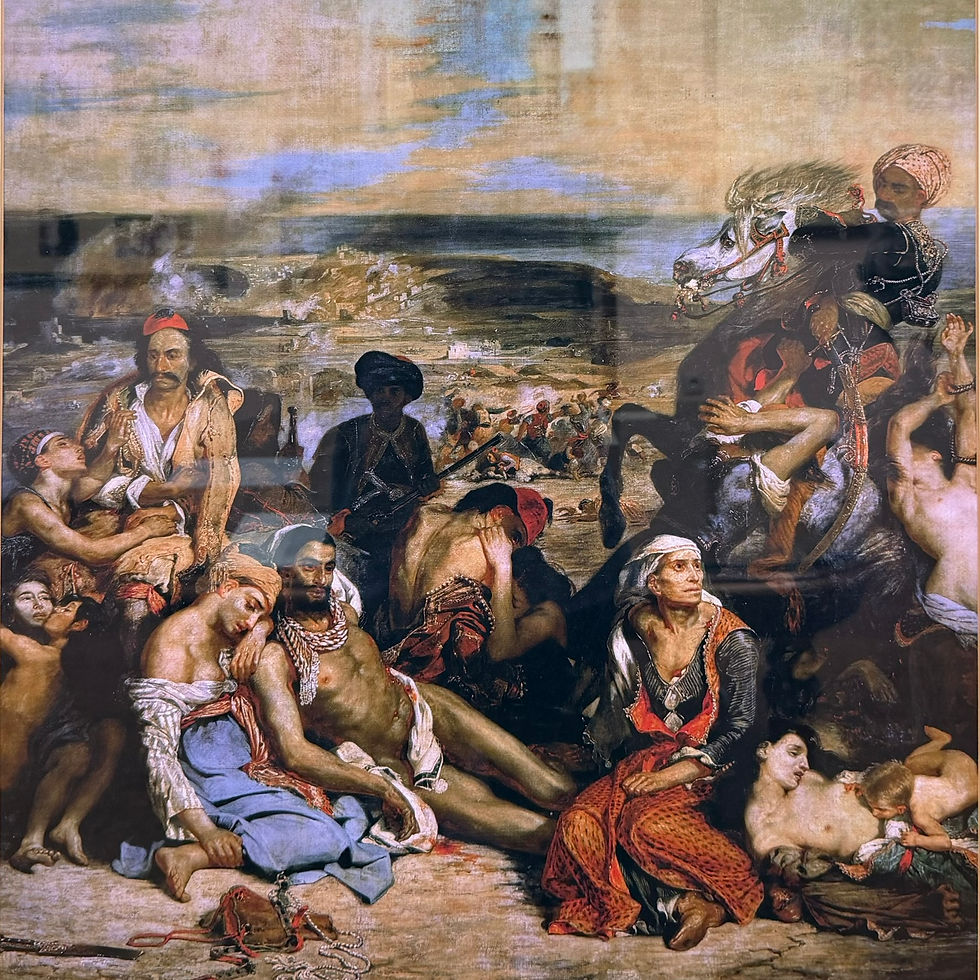
On a darker note, in both the Mastic Museum and the Citrus Museum there are reproductions of the painting by Delacroix entitled ‘The Massacre at Chios’, inflicted on the Chios people by Ottoman forces as part of the lengthy Greek War of Independence.
The massacre took place in 1822, and one museum states that 40,000 were slain and a further 50,000 survivors were taken away as slaves. Works by this French artist, amongst works by other western European artists and famous poets, helped raise awareness of the plight of modern Greeks and a ramantic support for their independence. Nevertheless, Chios was not included in the first modern Greek state, and the Chians had to wait until the First Balkans war for liberation from the Ottoman Turks.
The Chian diaspora had been busy in the meantime plying their maritime business, albeit under the convenience flags of Britain or Russia. They financed and insured their fleets from maritime capitals, especially London. Many of the mid-20th century Greek merchant fleet was built in British shipyards, and we saw many scale models of them, two years ago, in the wonderful maritime museum of Oinousses. The Greeks also bought many “Liberty ships” from the Americans following WWII. We British and Greeks have strong historical ties, not just through the late Prince Philip.
Anyway, it’s up to you, dear reader, to decide to what extent the current appearance of Chios is a result of the Prophet Mohammed’s expansionary visions, and the effect it had on a city on the Ligurian coast of Italy all those years ago.


Comments