
Alors, c’est la guerre
- Oct 28, 2025
- 4 min read
Updated: Nov 14, 2025

We have neighbours of several nationalities on Pontoon C: Italian; Swiss, French, and German amongst others. I said “Buongiorno” to one lady I had not met before, and she chastised me for using too hard an accent. “I am not a German”, she said. “You must say it softly, ‘moo an sherno’. Not ‘bonn dgerno!’” I repeated what I had heard. “Bravo”, she nodded approvingly.
I relayed this encounter to our regular Italian neighbour, Sergio. He’s from Perugia. He called out to me: “Richard, Italian is the language of love, French is the language of diplomacy. German is how you speak to a dog!”. His other floating neighbour, within earshot, was German, but Sergio smiled and assured me Herr Yachtie has a good sense of humour.
And so, it was in la langue française that, on October 28, 1940, Greek dictator Ioannis Metaxas told Mussolini’s ambassador, “Alors, c’est la guerre”. Followed by “Oxi”, pronounced ‘ochi’. (This does not mean OK in Greek, but “No!”).
After June 1940, Britain had no foothold on the continent, and Churchill was using all his tactical nous and diplomatic charm to find a way to scupper Hitler’s advances eastwards to secure resources. The Axis powers already included Italy, Hungary and Romania, and Germany relied heavily on Romanian oil for its war machine. But it needed to secure further sources of the black stuff.
Churchill lobbied the Soviets to switch alliances, but in vain. He also gave British support to Yugoslavia, and Greece, as he saw the Balkans as the “soft underbelly” at which to mount a potential counter-attack.
Similarly, Hitler regarded the Balkans as his weak right-flank that needed protecting as he stormed further east towards Russia.
Mussolini, Hitler’s lapdog, tried to curry favour by making a move unilaterally across the Adriatic to secure Greece. He had already annexed Albania, but now threatened Hellas. In his own fantasies, he was really trying to build the New Rome. After all, the first Romans had conquered Greece two millennia before. But Metaxas had refused to open the door, and to join the Axis powers. Perhaps emboldened by Churchill’s promised support, he said, ‘Oxi’.
The relatively modern Italian army had many men, and tanks, and air cover, as they crossed the border southwards from Albania in the Pindus mountains. To this day, the Greeks do not like the Albanians. The Greeks had fewer men, using horses and mules. Britain provided some RAF air cover, and ammunition.
The terrain did not help the Italians, nor did the freezing conditions in the mountains. But it was logistics that proved crucial; whereas the Greeks could maintain their supply lines, the Italians struggled, with the Adriatic Sea proving a weak link. The italians do like to be kept topped up with hot pasta.
The Greeks resisted the Italian advances, and even made counter-offences into Albania. Mussolini was humiliated, but the Fuehrer was furious. Adolf was worried that the British would establish air bases in Greece, and then attack his supply lines, especially his precious Romanian oil sources. So, he would have to do the job himself. In the Spring of 1941, instead of attacking Russia, he ordered a south-wards advance through Yugoslavia and Bulgaria (also not a friend of Greece). Despite a small force of British and Anzac troops, Greece was overwhelmed by the much greater Axis powers.
With his right-flank secured Hitler could now press on with Operation Barbarossa – the eastwards invasion of Soviet territories. But, crucially, instead of his planned spring campaign, the Greek diversion meant that it was now already June. Russia’s brutal winter arrived and the rest, as they say, is history.
Some say that without the delay in Greece, Hitler would have won on the eastern front, and WWII might have had a much different ending. Who knows? Churchill said that, “Hence we will not say that Greeks fight like heroes, but that heroes fight like Greeks.”
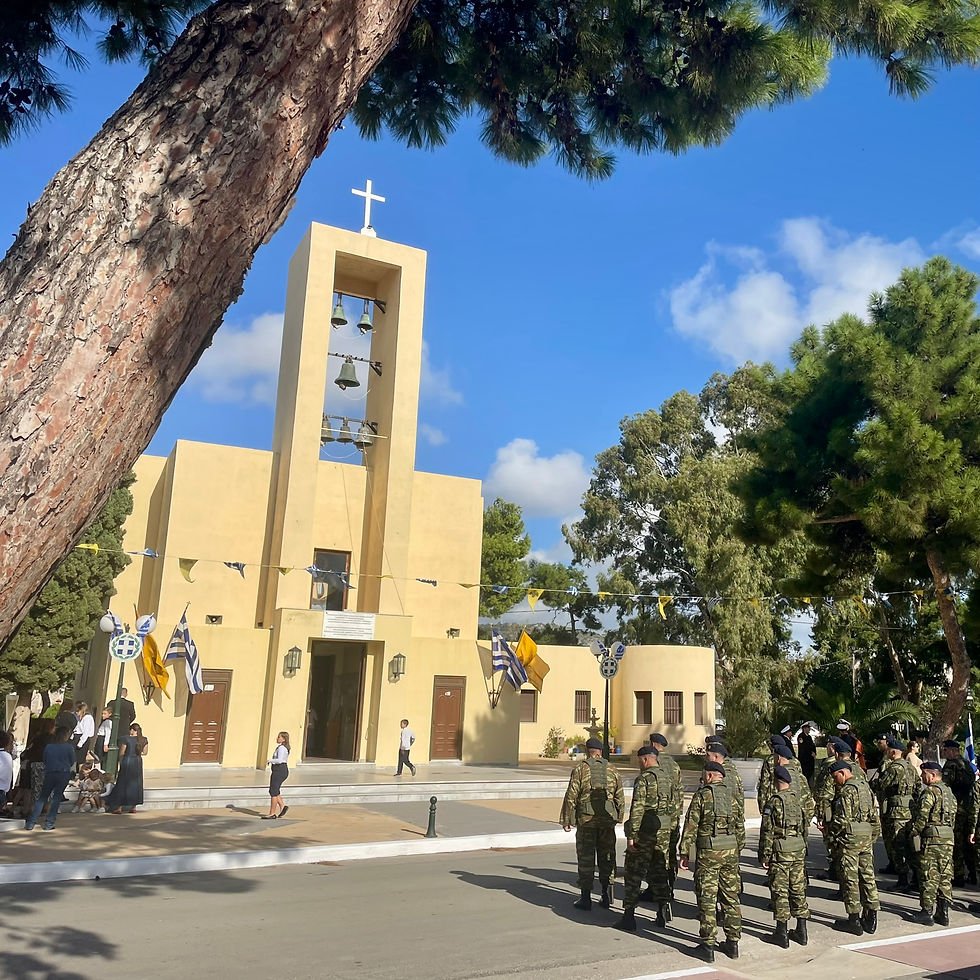
Anyway, the Greeks are a very proud nation, and Oxi Day is a national holiday. Every city, town and village has religious services, with bells ringing, and parades with marching bands, marching schoolchildren, and small children being ushered along wearing national costume. The Greeks like to fly the national flag at any time of year, but today there were thousands flapping in the stiff breeze.
As each of the island’s village schools proceeded past in turn, the quality of marching seemed to improve with age. As Alix quipped to me, “There’s only our Johnny who’s marching in time…”
Professionalism and years of training meant that the army lads were actually in time, and in step, when they marched by. Earlier, outside Lakki cathedral, I was standing behind the army lads in their camouflage fatigues, studying their boots. Some of the lads had polished them properly, but not many. My mum would have been appalled. But as they had bayonets fixed, I remained silent on the matter.

I could not avoid noting the irony of a Greek ceremony celebrating the rebuff of an Italian invasion ordered by Mussolini, that was taking place outside a church built in the 1930’s by Mussolini’s own architects. (As you know, the Dodecanese had been Italian since 1912 following the Italian-Ottoman war.)
At the formal ceremony in the square, discipline waned somewhat. During the speeches, the band members lost formation, some laid their instruments on the ground, and others broke ranks to chat to nearby friends or family. Even some of the dignitaries could not find it within themselves to respect the speakers. One balding suit with no tie spent most of his time on his mobile phone, and then looked up to chat to his much-smarter neighbour, who seemed a bit non-plussed. To be honest, there was far more discipline at our Methodist chapel on Sundays, when the scouts and guides were on parade.
Nevertheless, it is Greece, where family is king and everyone was having a lovely time. And they are still free to do as they please. Sometimes it’s better to say, “No!”


Comments