
Butterfly Island
- Oct 20, 2025
- 4 min read
Updated: Nov 12, 2025


As well as the Knights Hospitaller, the Latins and Franks more generally liked to build a nice castle. The crews of Missy Bear and Money Penny have wandered around the earthquake-smitten ruins of our latest Latin edifice, on the remote Aegean island of Astypalaea.
The island is shaped like a butterfly, its two mountainous wings linked by a narrow, rocky isthmus. It is quite barren and sparsely developed, with the main town or Chora on the southern end of the west wing. Although part of the Dodecanese, the island is said to have a character and ecology more similar to the islands of the Cyclades – sugar-cube houses and blue domed churches clustered on parched, scrub-covered rock.
Interestingly, a single tusk of a large, dwarf elephant, was excavated from the island during the 1990s. That would have been an even longer (perhaps even fancifully long?) swim that for our elephants found on Tilos! (see provious blog).

As usual, the Chora is perched up on a hill, to offer some protection from the pirates that terrorised these parts. Every substantial island was plagued by pirates of different nationalities, and the local population took shelter in their local fortification. Most of these fortresses were strictly military in character, with thick walls flanked by towers or spurs, even though they might enclose substantial settlements inside. However, the castle here is unique, because the fortification was provided by the settlement itself: an outer ring of private houses, most of them three-storeys, forming a continuous defensive screen on top of the steep hill. Only the gatehouse and a tower-like building on the south side appear to have been primarily defensive in character.
As a slightly macabre aside – and as a reminder of for how long these remote islands have been settled by humans - a graveyard lies on the west side of the hill, where at least 2,700 newborn and small children were buried in ceramic pots. This occurred between 750 BC and Roman times. It is the largest child and infant cemetery in the world!
Anyway, who built this castle? As we now well know, in 1204 Venice had paid a very major role in the Fourth Crusade, providing the navy for the Franks. The ‘March Pact’, after the shameful sack of Constantinople, set down rules for the division of Eastern Roman (Byzantine) loot; the Venetians would get three quarters of the proceeds, until their debt (for shipbuilding) of 150,000 marks was paid off by the Frankish knights. Thereafter the spoils would be divided equally.
Venice was happy for the Frankish knights to have land to create their fiefdoms, but Venice wanted strategic ports to maintain and secure her trading routes.

Although the Byzantine Greeks retained three ‘rump states’, the Venetians were granted three eighths of Constantinople, including its docks and arsenal. Plus, they were also awarded all of western Greece, Corfu and the Ionian islands, bases and islands in the Aegean, and control of the sea lane to Constantinople.
The Aegean islands became a duchy (the Duchy of the Archipelago), centred on the islands of Naxos and Paros. The duke and founder, Marko Sanudo (a relative of the Doge), conceded Astypalaea to a Venetian noble called Giovanni (John) Querini. It was he who founded the lodgings that formed the centre of today's Chora.
Giovanni stayed in Astypalaea – which the Venetians called Stampalia - from 1207 to 1269, even though the Byzantines had retaken the island. In 1310 Giovanni Querini II re-took Stampalia, and the Querini family remained the rulers of the island for about 300 years.

They eventually added ‘Stampalia’ to their surname. The castle itself was founded in 1413 by Giovanni Querini IV. He had to repopulate Astypalaea, after it had been completely deserted following a major Ottoman raid, and he brought in settlers from the islands of Tinos and Mykonos.
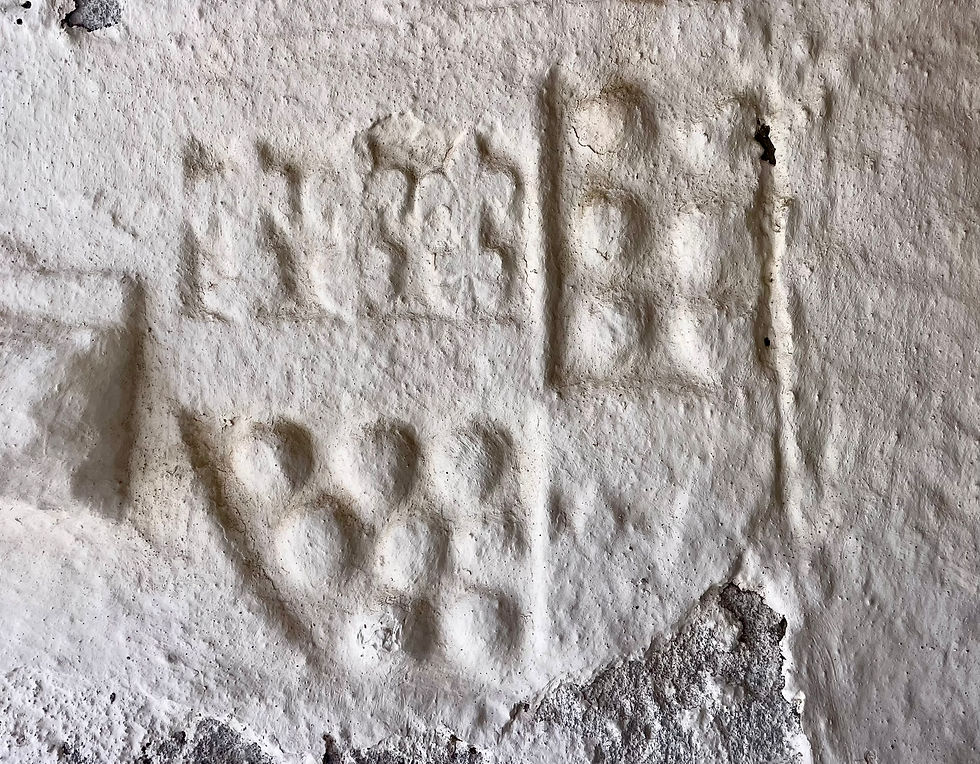
The Querini coat of arms can still to be seen built into the castle walls; a shield with a horizontal band with three fleurs-de-lis. Also, on the wall next to one family crest is another coat: it is the Querini crest quartered with nine roundels.
My research says this was the personal coat of arms of Fantino Querini (1433-1452). He was also a Knight Hospitaller, and the commander of the islands of Kos, Kalymnos, Leros and Nisyros. But I can’t find any reference to his being on Stampalia.

Despite the fortifications, our old friend Barbarossa, took the island in 1537, and it remained part of the Ottoman Empire (until 1912, when Italians returned). The Ottoman fleet went out collecting taxes once a year, but generally left the Christian populations of the islands to their own devices. That meant that the locals had to live with piracy, and often collaborated with pirates. Missy Bear visited some of the many sheltered anchorages around the island, that would have been perfect pirate lairs.
As a slightly political footnote, I get very tired of the current fashion of bashing Britain and its empire. One fact that often gets overlooked, as well as the Royal Navy’s work in eradicating the Atlantic slave trade, is the work they did in the 18th and 19th centuries in stamping out the piracy and Christian slave-taking by the Muslim pirates operating from the north African (Barbary) coast. It was only after the efforts of Britain, helped by other allied navies, that the residents for these Aegean islands felt safe enough to leave the comfort of the Choras, and to migrate and settled down at sea level, and so establish new ports.
And let’s not forget that without the help of the Royal Navy, the modern independent Greek nation could never have been freed from Ottoman rule.
[i] The Eastern Roman (Byzantine) Greeks called anyone from the Italian republics Latins, and anyone west of there, Franks
[ii] Missy Bear visited the later fort of Naoussa in 2022.



Comments