
Top of the ladder
- May 23
- 4 min read
Missy Bear had a long journey ahead of her (about 50 NM) to get to Lemnos, the historic Gateway to Constantinople. So, we cast off early at first light (05:30) and headed north-west, on a course of 295 degrees. The breeze filled in steadily from the north-east, and we were sailing on a fine reach towards our destination, probably Moudros Bay on the south-east corner.

We were on alert as we were crossing the main shipping routes in and out of the Dardanelles, and so Istanbul and the Black Sea. Tankers, container ships and the odd cruise liner crossed in front of us and behind us from both directions.
We were using the electronic navigation aids, based on AIS, to predict how close to us the vessels would pass. But we also backed that up with readings from the good old hand-bearing compass: if the ships showed a constant bearing to Missy Bear over time, we were on a collision course, and would have to alter course. Even though we were a sailing vessel - and so technically with right of way over power driven vessels - the captains of these mega-ships would not be too keen to alter course for a minnow if they could help it.
We had made good time sailing and decided to press on further west towards our final destination for this trip, Myrina. We ended up anchoring just a few miles south in Platy Bay, a large sandy bay with clear water, in which we had ridden out some strong winds two years previously. We had covered 64NM in 11 hours. I paddled over to the beach to check out the beach bars, but they were all closed as the season has not really started.
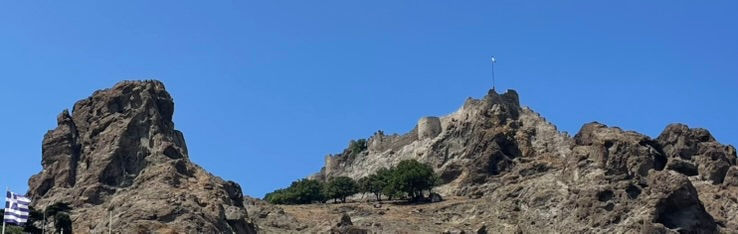
Next morning we motored the short distance, into a bit of a sea, to the beautiful old town of Myrina. We moored-up stern-to the quay, under the looming presence of the imposing castle. We plugged into shore power and topped up our water.
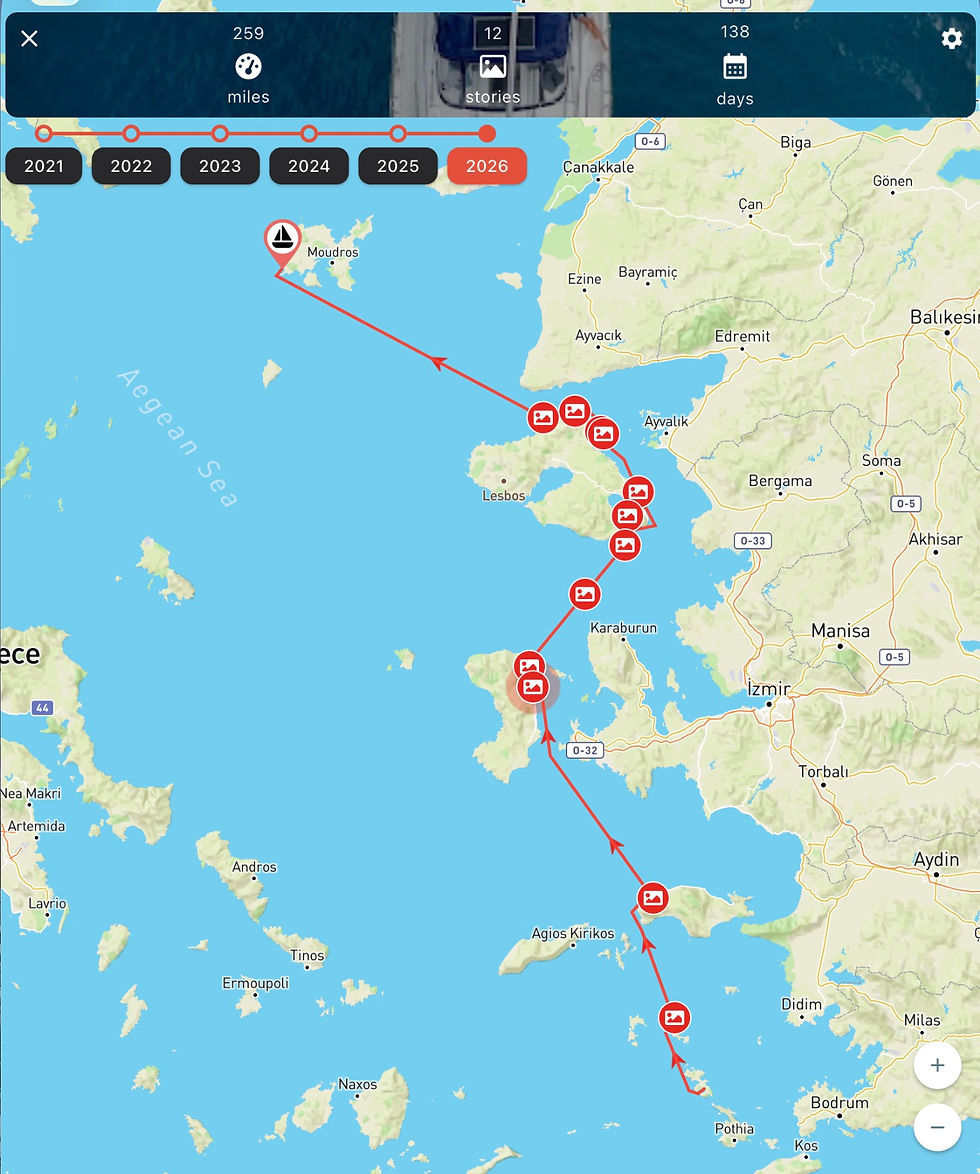
Missy Bear had covered 264 NM in 10 days. We had had some very favourable weather, and lots of fantastic sailing.
Tony and Lynn were to jump ship here, to fly to Athens, and then back to the UK. We managed a couple of evening of cards and aperos in the more modern bars on the northern bay, as we watched the sun set behind the iconic Mount Athos, some 30 NM away on the mainland.
A new part arrived from Athens just in time for me to install with Tony’s assistance. It was a new control panel for the retractable bow-thruster. The old one was 5-years-old, and when you hit the buttons to swing the bow left or right, sometimes the bow thruster reacted, and sometime it didn’t. When you need the bow thruster, you really do need it. Right there and then; it’s really a safety issue. I had noticed the problem had got worse in Lesbos, so I had ordered the part there, and asked the merchant to courier it to Myrina. I took the 'Crew List' to the Port Police and had our two guests officially removed from Missy Bear's list of passengers.

Alix and I discussed whether we would continue north to the islands of Samothraki, Thasos and then to Kavala on the mainland, but decided that Lemnos would be the highest rung on the island ladder for Missy Bear this spring. If I wanted to see the old Roman aqueduct of Kavala, I could always visit by land instead. We would turn around and let the northerlies take us back in a leisurely manner over the next 5 weeks or so.
For the time being we would enjoy Myrina. We got some laundry done, and changed the gas bottle, and I will order a top-up of diesel before we leave.
Myrina has been inhabited since at least the Bronze Age, and there would have been ancient Greek buildings on the rocky, towering acropolis. A Byzantine castle was built on the acropolis by the Eastern Roman Emperor (between 1183 - 1185). After the sack of Constantinople by the “Franks”, Lemnos became the property of a Venetian noblemen, Filocalo Navigajoso, who repaired the castle. Later, the Genoese Francesco I Gattilusi (1373-1384) made significant additions.

Eventually the Ottomans took the island, the citadel and the town below: the northern bay, ‘Romaiikos Gialos’, was inhabited by Romans or Greeks, whilst the Ottomans lived in the old southern bay ‘Tourkikos Gialos’ and ruled from the castle, which they further extended and repaired.
The site's buildings suffered some damage during the ongoing Russian-Ottoman wars.
There was a mosque in the castle, as well
as one in the town below. But, after the Ottomans were expelled in 1912 following the first Balkans War, the mosques would have been destroyed. All that is left of the one in town is the fountain where the Muslim worshippers would have cleansed before entering to pray.
Today, the rocky headland is a lovely setting, and worthy of a couple of hours of scrambling amongst and exploring the ruins and wild flowers. Watched closely by the resident fallow deer, and the odd bobbing Wheatear.


Comments